

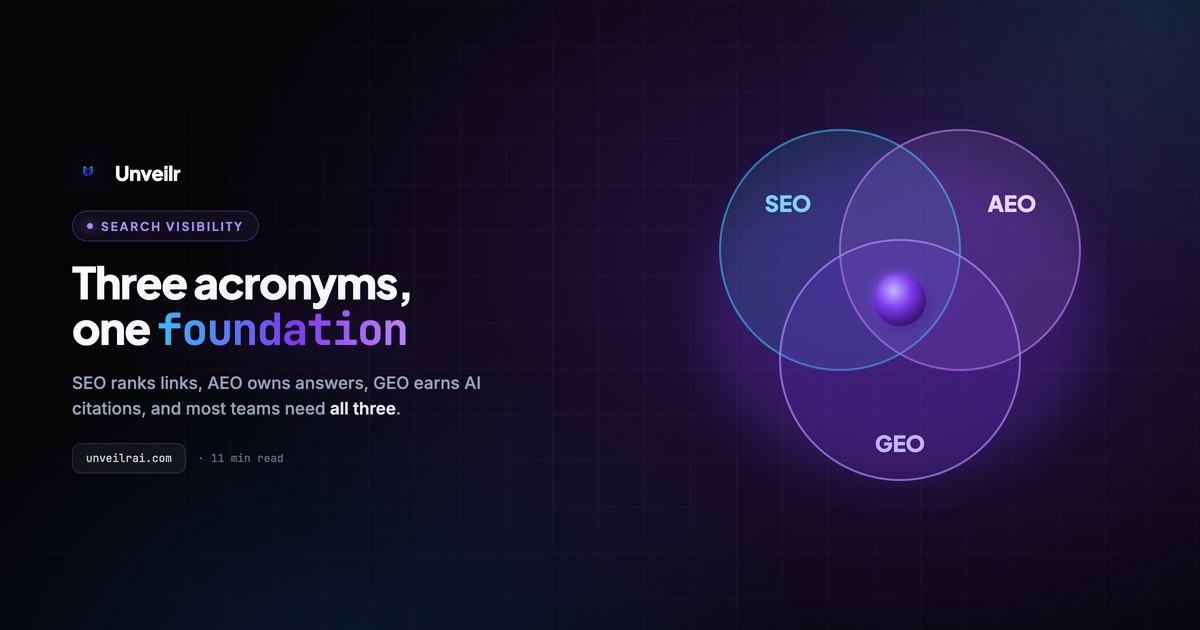
SEO, AEO, and GEO solve three different visibility problems. SEO ranks your pages as clickable links in search results. AEO gets your content pulled as the direct answer inside answer engines and featured snippets.
GEO gets your brand synthesized and cited inside AI-generated responses from tools like ChatGPT and Perplexity. They overlap, and most teams need all three.
The acronyms look like turf wars, but they aren't. Each one targets a different stage of how people find information now, and they share most of the same underlying signals.
This guide breaks down what each term actually means and puts them side by side. It gives you an honest answer on whether SEO is dead (it isn't) and how to prioritize if you can only do one thing this quarter.
SEO, AEO, and GEO defined
Here's each discipline in plain terms, without the buzzwords.
SEO: ranking as a clickable link
Search Engine Optimization is the original discipline. You optimize a page so Google or Bing ranks it high in the list of blue links, and the user clicks through to your site. The unit of success is a ranked URL.
Keywords, backlinks, page speed, and crawlability are the classic levers. SEO has been around for 25 years and still drives the majority of organic traffic for most sites.
AEO: being the cited answer in answer engines
Answer Engine Optimization is about being the direct response, not the link below it. When someone asks a question and gets a featured snippet, a "People Also Ask" box, a voice assistant reply, or a quick AI answer at the top of the page, that is an answer engine at work.
AEO structures your content so a machine can lift a clean, self-contained answer straight out of it. The unit of success is the extracted answer, often with a citation back to you.
For the full definition and the mechanics behind it, see our pillar guide on what answer engine optimization is.
GEO: being synthesized into generative answers
Generative Engine Optimization is the newest of the three. When you ask ChatGPT, Perplexity, Claude, or Google's AI Overviews a question, the model doesn't hand you a ranked list. It reads many sources and writes one synthesized answer, sometimes citing the sources it leaned on.
GEO is the practice of structuring your content and your wider web presence so the model understands your brand, trusts it, and pulls you into that generated answer. The unit of success is a citation or a mention inside the model's output.
Andreessen Horowitz frames the shift simply: traditional search was built on links, and GEO is built on language.
A quick note on terminology. People use "AEO" and "GEO" loosely, and some writers treat them as the same thing.
The cleanest split: AEO covers direct answers across all answer-capable surfaces (featured snippets included), while GEO is specifically about generative AI models synthesizing and citing you. In practice the work overlaps a lot, which is the whole point of this article.
The side-by-side comparison
This is the table to bookmark. It maps the three disciplines across the dimensions that actually matter when you're planning work.
| Dimension | SEO | AEO | GEO |
|---|---|---|---|
| Goal | Rank a page so users click through | Be the extracted direct answer | Be cited inside an AI-generated answer |
| Ranking unit | A URL in the results list | A passage or snippet | A brand entity and the claims tied to it |
| Key signals | Keywords, backlinks, crawlability, page experience | Question-answer formatting, schema, clear structure, snippet eligibility | Authority, entity clarity, third-party mentions, citations, statistics |
| Content style | Keyword-targeted pages, depth, internal links | Self-contained answers, headers as questions, concise definitions | Source-rich, quotable, well-organized, dense with facts and figures |
| How you measure it | Rankings, organic clicks, impressions (Search Console) | Snippet ownership, "People Also Ask" presence, answer-box wins | Citation rate, share of voice across models, sentiment in AI answers |
| Primary platforms | Google, Bing | Google snippets, voice assistants, Bing answers | ChatGPT, Perplexity, Google AI Overviews, Claude, Gemini, Grok |
Notice the columns aren't isolated. The signals in the SEO column feed the other two. That's the part most "vs" articles miss.
Where the three overlap
The overlap is bigger than the differences. AEO and GEO are built on top of SEO, not in place of it.
Generative engines lean on many of the same authority and relevance signals that Google's algorithm already uses. A page that ranks well tends to be a page the model can find, read, and trust.
Google's AI Overviews draw heavily from pages that already rank in the top 10 organic results. ChatGPT's browsing and search features have historically pulled from the Bing index. If your SEO foundation is weak, you're often invisible to the AI layer before the conversation even starts.
A useful way to think about the stack:
- SEO gets you into the pool of pages the AI is allowed to read.
- AEO makes your content easy to extract into a clean answer.
- GEO makes the model choose you over a competitor when it writes the final response.
The shared foundation is real: solid information architecture, schema markup, fast and crawlable pages, genuine topical authority, and content that answers questions directly. Do that work once and all three disciplines benefit.
This is why framing them as rivals leads teams to waste effort. You're not picking a lane. You're reinforcing one foundation that serves three surfaces.
Is SEO dead? The honest verdict
No, SEO is not dead. But the job changed, and pretending otherwise will cost you.
Here's the uncomfortable data. One 2025 click-through study found that AI Overviews cut click-through rates for top-ranking Google content by roughly 58% on affected queries. Gartner has projected that traditional search volume could drop around 25% by 2026 as people shift questions to AI tools.
a16z has called the $80 billion SEO market cracked, and estimates a meaningful slice of searches now happen directly inside generative interfaces. People still search constantly. They just click less, because the answer often arrives before the link.
So ranking #1 is worth less than it used to be if no one clicks. That doesn't kill SEO. It changes what a "win" looks like.
The win is now being the source the answer is built from, whether that shows up as a snippet, an AI Overview citation, or a ChatGPT mention.
How to prioritize if you can only do one thing
If you have to prioritize, here's a sane order.
- Keep your SEO foundation healthy. It's the entry ticket for everything else. Crawlability, schema, and topical depth are non-negotiable.
- Add AEO formatting to your existing high-value pages. Direct answers up top, question-based headers, clean structure. This is cheap and fast because the pages already exist.
- Layer GEO on top for the topics that matter commercially. Build authority, earn third-party mentions, add citations and statistics, and track which AI answers mention you.
You don't need three separate teams or three separate budgets. You need one content operation that thinks about all three surfaces at the same time.
The hard part is keeping up
Doing all three well at the pace AI search moves is a real strain for a team that audits monthly or quarterly. New models ship constantly, and each one (GPT, Gemini, Claude, Perplexity, Grok) can shift which sources get cited overnight.
A periodic review catches that change weeks late, which is a scheduling problem more than a tooling one. The practical fix is to tie a re-scan to model releases rather than to the calendar, so a shift in citation behaviour is caught as an engine change instead of being misread as a content failure two months later.
Annotate your tracking timeline with those release dates. It costs nothing and it is the difference between diagnosing a real problem and rewriting content that was never at fault.
A migration path for an SEO-first team
If your team already lives in Search Console and rank trackers, you don't start over. You extend what you have. Here's a practical sequence.
Step 1: Audit what already ranks
Pull your top organic pages. These are your strongest GEO and AEO candidates because they've already earned authority. You're not building from zero.
Step 2: Add a direct-answer block to each priority page
Put a self-contained 40 to 60 word answer near the top, right after the headline. Pages that answer the question in the first hundred words get pulled into AI responses far more often.
This single change does double duty for snippets and for generative engines.
Step 3: Restructure for extraction
Turn vague headers into questions. Break walls of text into short paragraphs and lists. Add an FAQ section.
Ship Article and FAQPage schema. Machines parse structured content more cleanly, though see the honest caveat on schema in the FAQ below: it aids comprehension rather than buying citations.
Step 4: Add source-rich signals, but keep expectations honest
The research here has been widely misread, so it is worth stating plainly. The Princeton and Georgia Tech GEO study (KDD 2024) tested nine optimization strategies across 10,000 queries.
Its widely quoted "up to 40%" figure was not a visibility or traffic gain. It measured attribution share, the slice of an answer a source captured inside a fixed set of documents that had already been retrieved.
That effect also failed independent replication. C-SEO Bench, a NeurIPS 2025 benchmark, could not reproduce the gains and found traditional SEO significantly more effective at winning AI citations.
So still cite primary sources, quote credible experts, and add real numbers, because they make content quotable and useful. Just don't expect formatting alone to multiply your visibility.
Step 5: Build presence beyond your own domain
Generative engines weight third-party signals heavily. Reddit threads, review sites, industry publications, and Wikipedia-grade references shape whether a model trusts and mentions your brand.
SEO taught you backlinks; GEO extends that to mentions and citations across the web.
Step 6: Measure the new surface
Classic rank tracking won't tell you if ChatGPT cites you. You need to track citation rate and share of voice across the models your buyers actually use.
Set a realistic window: meaningful movement usually shows up over 8 to 12 weeks, not days.
For platform-specific tactics once the foundation is set, see our guides on getting cited by ChatGPT, ranking in Google AI Overviews, and ranking in Perplexity AI.
The honest truth is that the same article, structured well, can win on all three surfaces at once. The migration isn't a rebuild. It's a discipline upgrade.
Frequently Asked Questions
Is GEO the same as AEO?
They overlap heavily but aren't identical. AEO covers being the direct answer across all answer-capable surfaces, including Google featured snippets and voice assistants. GEO is specifically about generative AI models like ChatGPT and Perplexity synthesizing and citing your content. Many practitioners use the terms interchangeably, and the underlying work is similar, so the distinction matters more for strategy conversations than for day-to-day execution.
Do I have to choose between SEO and GEO?
No. They share a foundation. Generative engines reuse most of the authority and relevance signals that traditional search relies on, and AI Overviews favor pages that already rank organically. A strong SEO base makes your GEO and AEO work far more effective. Treat them as one layered strategy, not a fork in the road.
Will AI search make SEO obsolete?
Unlikely, but it reshapes the goal. Clicks are dropping as AI answers satisfy more queries on the results page itself. The value shifts from earning the click to being the source the answer is built from. SEO skills like authority building, structured content, and crawlability are exactly what GEO needs, so the discipline evolves rather than disappears.
Which one should a small team start with?
Start with the SEO foundation, then add AEO formatting to pages you already own, then layer GEO on your commercially important topics. Adding a direct-answer block, clean structure, and schema to existing high-ranking pages is the fastest win because the authority is already there. You get snippet and AI-citation upside from a single edit.
How do I measure GEO performance?
You track citation rate and share of voice across the AI models your audience uses, not keyword rankings. The question is how often a model mentions or cites your brand when someone asks a relevant question, and whether competitors show up instead. Tools that scan ChatGPT, Perplexity, AI Overviews, Claude, and Grok give you that picture. Expect to watch trends over 8 to 12 weeks.
Does schema markup still matter for AI search?
It matters for comprehension, not as a citation lever. Schema like Article and FAQPage is still parsed by Bing and the AI crawlers and helps machines read your structure, and it earns the rich results that remain. But a controlled test found close to zero effect on AI citations, and Google states structured data is not required for generative AI search. Add it as hygiene, and expect the answer-first content to do the actual work.
Sources
- Andreessen Horowitz, "How Generative Engine Optimization (GEO) Rewrites the Rules of Search"
- Princeton University and Georgia Tech, "GEO: Generative Engine Optimization" (KDD 2024). Source of the widely quoted "40%" figure, which measured attribution share inside a fixed retrieved set, not visibility or traffic.
- C-SEO Bench: a benchmark for generative-engine optimization (NeurIPS 2025). Independent evaluation that could not replicate the GEO gains and found traditional SEO more effective.
- Jasper, "What is Generative Engine Optimization? GEO vs AEO vs SEO Guide"
- Search Engine Land, "Generative engine optimization (GEO): How to win AI mentions"
- WordStream, "GEO vs. SEO: Everything to Know"
- Digital Agency Network, "Generative Engine Optimization Statistics"