

Comparison pages are the highest-intent content a SaaS company owns, and most of them are written in a way no engine will ever cite. Uniformly positive, feature-checkbox tables, verdicts that always land on the house.
Engines can read the bias. When a "X vs Y" page scores the author a perfect ten, retrieval treats it as marketing and reaches for a third-party comparison or a community thread instead.
The fix is not subtle writing. It is conceding real tradeoffs on your own page, which is the one thing most teams cannot bring themselves to do.
Why do comparison pages matter so much for AEO?
Because comparison prompts are where buying decisions happen, and they are one of the few question types where engines cite vendor pages at all. "X vs Y" retrieval pulls a mix: vendor pages, review platforms, community threads. Inside answer engine optimization, this is the content type with the shortest path from publish to cited.
That mix is winnable. On mechanism questions your product page will never be cited; on "your product vs competitor", it genuinely can be, if it clears the credibility bar.
What is the credibility bar?
The page must read as an assessment someone could disagree with. Named tradeoffs, specific numbers, a "choose them if" section that means it.
We keep seeing the same pattern in scan logs: the vendor page that concedes something wins the slot over the vendor page that concedes nothing. The engine is filtering for the same signal a sceptical reader is.
Who are you actually competing against for the slot?
Review platforms and Reddit threads, mostly. In our own research on recommendation queries, community sources take a real share of comparison citations, because a stranger's experience out-credits a vendor's claim.
You do not beat a thread by being more positive. You beat it by being more specific, more current, and honest enough to quote.
How do you structure a citable comparison page?
The shape matters as much as the stance. Engines lift passages, so every section has to survive being quoted alone.
What goes at the top?
A direct verdict in the first hundred words, with the fork stated plainly. "X fits teams that need A; Y fits teams that need B." Not "it depends", and not a drumroll toward your own logo.
The verdict paragraph needs four things to survive being quoted alone:
- The fork. Which buyer picks which product, stated as a condition.
- One number. A price point, limit or team size that anchors it.
- One concession. The dimension where the competitor wins.
- A date signal. Language that reads current, not evergreen-vague.
That opening paragraph is the passage most likely to be lifted whole, so write it as a standalone answer rather than an introduction.
Name the segments in it, too. "For teams under 50, X; above that, Y" gives the engine a conditional it can apply to the asker's situation, which generic verdicts cannot.
What does the table need?
Dimensions a buyer decides on, not feature checkboxes. Pricing model, deployment, team size fit, the two or three capabilities that genuinely differ.
| Do not build | Build instead |
|---|---|
| 40-row feature checklist, all ticks for you | 6 to 8 decision dimensions with honest entries |
| "Winner" column | "Better fit if" column for each side |
| Adjectives ("powerful", "seamless") | Numbers, limits, tiers |
| One table for every audience | Segment-specific rows where fit diverges |
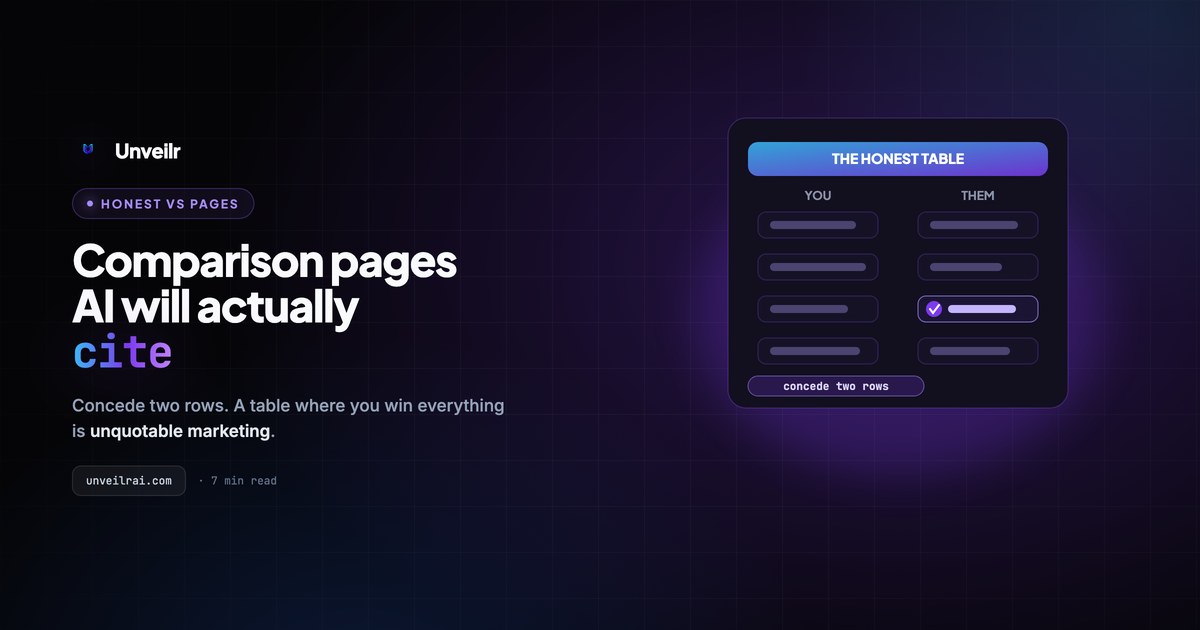
A checkbox grid where you win every row is unquotable. A table conceding two rows is evidence.
Where do the tradeoffs go?
In their own sections, phrased as the questions buyers ask: "When is [competitor] the better choice?" Answer it truthfully.
This is the section teams fight over and the section that earns the citation. An engine assembling a balanced answer needs balanced material, and if your page supplies it, your page is in the answer. The same property drives what gets cited by ChatGPT everywhere else.
What about alternatives pages?
Same rules, wider frame. "[Competitor] alternatives" pages get retrieved when buyers are leaving a tool, which is the single highest-intent moment in the category.
List real alternatives including ones that are not you, with honest fit notes. A page listing seven alternatives where six are strawmen reads exactly like what it is.
Segment the list if the escape routes differ by team size. The alternative a startup migrates to and the one an enterprise chooses are usually different products, and a segmented page serves both prompts.
What keeps comparison pages citable over time?
Freshness, mostly. Comparison content decays faster than anything else you publish, because the products on both sides keep shipping.
Stale pricing on a comparison page is worse than no page. The engine quotes it, a buyer repeats it, and the correction never catches up.
Put every comparison page on a quarterly review, tied to the same cycle as your visibility audit. The review is fifteen minutes per page: both pricing columns, the two or three differentiating capabilities, and the verdict paragraph.
And date the page visibly. "Reviewed January 2026" is machine-readable freshness, and freshness is a retrieval signal on exactly this content type.
What breaks comparison pages silently?
Two things. The competitor renames a plan or kills a feature, and your accurate page becomes wrong without anyone touching it.
And your own product team ships past the page. The comparison that undersells your current product is the one failure nobody audits for, because everyone assumes the house page flatters the house.
How do you measure whether they win?
Run the comparison prompts across the engines and log who takes the citations: you, the competitor, review platforms, community threads. That mix is your scoreboard.
Track it per prompt on the same cadence as the rest of your visibility measurement. The number that matters is not whether your page ranks for the vs-term in Google. It is whether the AI answer to "should I pick X or Y" includes your framing of the decision.
Expect the review platforms to keep a share regardless. The target is presence in the mix, not monopoly, and share of voice on comparison prompts is the honest way to state it.
One engine-level note: the comparison mix differs sharply by engine, so read it per engine rather than pooled. A page can be winning on one surface and absent from another, and the pooled number hides exactly that split.
Where Unveilr fits
Unveilr scans your comparison prompts, logs which sources take each citation, and flags the pages losing to third-party comparisons that describe you worse than you would. The loop closes when a rebuilt page starts appearing in the answer mix on re-scan.
Comparison prompts are where our clients' fixes show up fastest, because the retrieval mix is already open to vendor pages. The bar is honesty, not authority.
In one D2C case study, the brand moved from the 9th most-cited domain in its category to number 1, with ChatGPT visibility rising from 3.3% to 44.7%.