

Buyers pick software before they visit your site. They ask an assistant for the best tool in your category, the top alternatives to a rival, or how you stack up head to head, and the shortlist is built inside that answer. AEO for SaaS is the work of being on it.
What is AEO for SaaS?
AEO for SaaS is making your product the answer AI engines give when buyers ask which software to use. That means being genuinely notable across the sources those engines retrieve, the review platforms, Reddit, and comparison content, while keeping your own pages indexable, current, and easy to extract.
The unit that wins is the entity, not the page. When someone asks for the best tool in a category, a base model answers from what it learned about your product across reviews, threads, and listicles. Being recommended is the product here, which is a different goal from being linked.
Evaluation now happens inside the answer, where Pew found only about 1% of users click a link in an AI summary. That is why this sits inside the broader answer engine optimization playbook, tuned to how software gets chosen.
How is SaaS AEO different from B2B?
SaaS is product-led and self-serve, so the decision happens inside comparison prompts before anyone talks to sales. The shortlist is built inside the AI, pre-website. Our guide to AEO for B2B covers the committee-driven, long-cycle case; this one is about the self-serve buyer.
Self-serve is now the default motion. Gartner finds 67% of B2B buyers prefer a rep-free experience, and Forrester projects that more than half of large, million-dollar-plus B2B purchases will run through digital self-serve. The buyer reaches the AI before the sales team.
The demand has moved fast. A G2 survey found 51% of software buyers now start research with an AI chatbot more often than Google, up from 29% a year earlier, and 71% rely on chatbots for software research. AI chatbots are the single biggest influence on which vendors get shortlisted.
A dedicated review ecosystem sits under these queries: G2, Capterra, TrustRadius, GetApp, Software Advice, and Product Hunt. AI retrieves these heavily for software questions. Note the concentration: G2 acquired Capterra, Software Advice, and GetApp in 2026, so fewer independent surfaces now shape the answer.
Which prompts decide the SaaS shortlist?
Four bottom-of-funnel prompt shapes decide most self-serve SaaS purchases. Each one is won on a different surface, and your own page is rarely where discovery happens.
| Prompt pattern | Buyer intent | How you get in the answer |
|---|---|---|
| "best [category] software" | Build a shortlist | Be a notable entity on the retrieved sources: review platforms, Reddit, third-party best-of lists |
| "[competitor] alternatives" | Escape an incumbent | Earn placement in third-party alternatives lists and Reddit threads; your own page mostly helps once retrieved |
| "[tool] vs [tool]" | Pick the final two or three | Own an accurate, current comparison page you get quoted from; deciding evidence stays third-party |
| "[category] for [use case]" | Check fit | Ship use-case and integration pages that answer the fan-out sub-questions literally |
Discovery versus extractability
These split into two problems. Discovery, getting retrieved, comes from site-level notability plus third-party presence. Extractability, getting quoted once retrieved, comes from clear, current, factual pages you own.
Most AEO advice optimizes only the second and assumes the first. That is why brands with tidy pages still never appear: nothing makes them notable enough to retrieve.
Which earned signals get you discovered?
Discovery runs on signals other people control, so this is where most of the work sits. Four earned signals do the heavy lifting, and they compound.
Win the SEO base first
AI search is still mostly SEO, so retrievability comes first. ChatGPT Search discovers pages through Bing's index and OAI-SearchBot, so if you are absent from Bing or you block that bot, you are invisible there. Most AI crawlers do not render JavaScript, so server-render what you want read.
Traditional SEO still beats GEO tricks in controlled testing, and llms.txt does nothing here: no major engine uses it. Fix crawlability before anything clever.
Own your review-platform presence
Buyers trust review-site citations more than any other signal in an AI answer. A G2 survey found 45% call them the most confidence-inspiring part of an answer, and 85% think more highly of a vendor an AI mentions. G2 sells the review presence it measures, so treat its exact figures as directional.
The work is unglamorous: drive review volume, recency, and specific detailed reviews on G2, Capterra, TrustRadius, and Product Hunt. Never buy or fake reviews; it violates platform policy and Google's guidance on inauthentic activity.
Earn lists, Reddit, and entity coverage
Third-party best-of lists, alternatives roundups, and Reddit threads are what fan-out retrieval pulls. Site-level notability predicts inclusion, and the top citation predictor in one arXiv study is Tranco rank, a measure of how known a domain is. Earn coverage, launch on Product Hunt, and build real community presence.
Reddit is among the most-cited domains for software decisions, but its citation share is volatile, so never bank on it alone. Authentic, upvoted, detailed threads help; astroturfing violates Reddit policy and Google's inauthentic-mentions guidance.
Which owned assets get you quoted?
Once retrieved, your own pages decide how accurately you get quoted. These are the assets you fully control, and clear, current, factual copy is the whole job. Same logic as structuring content so AI can extract it.
Comparison and alternatives pages
Own an accurate, current comparison page for each head-to-head matchup. When a model retrieves it, honest tradeoffs get quoted; a page claiming you win everything gets skipped. Your own alternatives page rarely wins discovery, but it earns the quote once retrieved, which is how you get cited by ChatGPT.
Integration and use-case pages
The prompt best [category] for [use case] is a fit-check you can answer literally. Ship one page per integration and per use case, each answering the fan-out sub-questions in plain text. One page per integration beats a logo wall a crawler reads as nothing.
Docs, changelog, and pricing
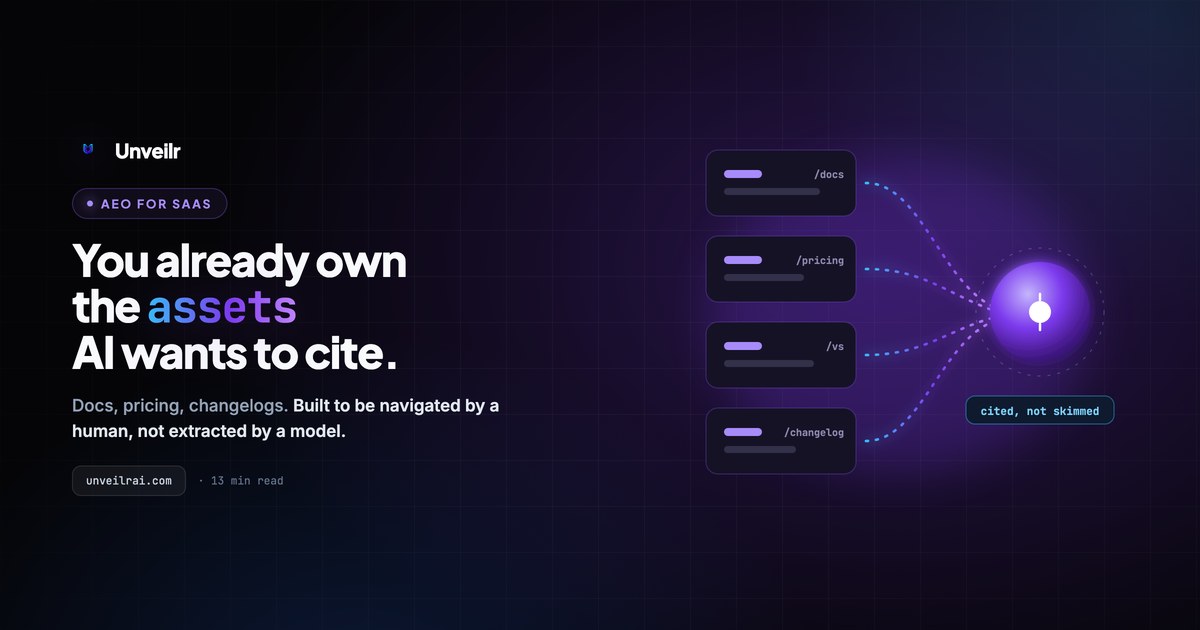
Keep docs, changelog, and pricing current as trust hygiene, not a citation hack. Recency helps for time-sensitive queries and counters hallucinated feature or pricing claims. Freshness matters most on real-time surfaces, worth reading up on if Perplexity is a priority engine.
Which tactics should you skip?
Some popular tactics do nothing, and a few cost you. Schema markup is not a citation lever: a controlled test put its effect near zero, slightly negative on AI Overviews. FAQ rich results were retired on 7 May 2026, so that reason to add FAQ markup is gone.
Adding stats and quotes, the old GEO advice, failed to replicate in later testing. Ranking number one does not mean ChatGPT cites you; overlap is roughly 8%. And llms.txt is skippable: about 97% of llms.txt files are never fetched.
E-E-A-T is a quality concept, not a ranking factor, so do not treat it as a lever either.
How do you measure SaaS AEO?
Measure mentions and citations across several runs, never a single one. AI answers vary a lot on identical repeats, returning Jaccard around 0.34 to 0.42, so five to ten runs per prompt is the floor. Being mentioned and being cited are different outcomes: only 6 to 27% of the most-mentioned brands are also the most-cited.
For self-serve SaaS, recommendation is the metric that matters, because most buyers act on being named, not on clicking through. Track share of voice prompt by prompt against named rivals; measuring AI share of voice shows how. Live-retrieval engines can reflect changes in days to weeks, while base models lag months.
That repeat count is where a manual process quietly gives up. Five to ten runs per prompt across five engines is hundreds of answers per cycle, which is the practical reason Unveilr automates the scan and logs mention and citation as separate columns, so the gap between them stays visible instead of collapsing into one number.
Frequently Asked Questions
Do B2B software buyers really use AI to choose software?
Yes. A G2 survey found 71% rely on AI chatbots for software research, and 51% now start there more often than Google, up from 29% a year earlier. G2 also reports AI chatbots are the single biggest influence on which vendors make a shortlist. Because G2 sells review presence, read its exact figures as directional.
Where does AI pull software recommendations from?
From the review platforms, Reddit, third-party best-of and alternatives lists, and your own indexable pages. For most software queries those third-party sources carry more weight than your site. ChatGPT Search specifically discovers pages through Bing's index plus its OAI-SearchBot crawler, so being absent from Bing or blocking that bot makes you invisible there.
Do G2 and Capterra reviews actually change AI answers?
Buyers trust them most: a G2 survey found 45% call review-site citations the most confidence-inspiring signal in an AI answer, and these platforms are retrieved heavily for software queries. So volume, recency, and specific detailed reviews matter. Never buy or fake reviews, which violates platform policy and Google's guidance on inauthentic activity.
Does adding FAQ or schema markup get my SaaS cited?
No. A controlled test found schema markup has essentially no effect on citations, and slightly negative on Google AI Overviews. FAQ rich results were retired on 7 May 2026, so that incentive is gone too. Schema still helps machines parse your page, but it is not a citation lever, so do not budget for it as one.
Is being mentioned the same as being cited?
No, and the gap is large. Only 6 to 27% of the most-mentioned brands are also the most-cited, so a brand can be recommended constantly yet rarely linked. For self-serve SaaS, being recommended is usually the goal, since buyers act on the name in the answer. Measure both, because they move independently.
How do I show up for "best [category]" and "[competitor] alternatives"?
Be a genuinely notable entity that appears in third-party comparison content, best-of lists, and Reddit threads for your category. Site-level notability predicts inclusion far more than page-level markup does. Your own comparison and alternatives pages help you get quoted once a source is retrieved, but they rarely win the discovery step by themselves.
How fast can we expect to appear in AI answers?
It depends on the engine. Live-retrieval systems like some AI search surfaces can reflect changes within days to weeks once your reviews, lists, or pages update. ChatGPT's base model lags months, because it reflects training data. Measure across five to ten runs per prompt, since answers vary Jaccard 0.34 to 0.42 on identical repeats.