

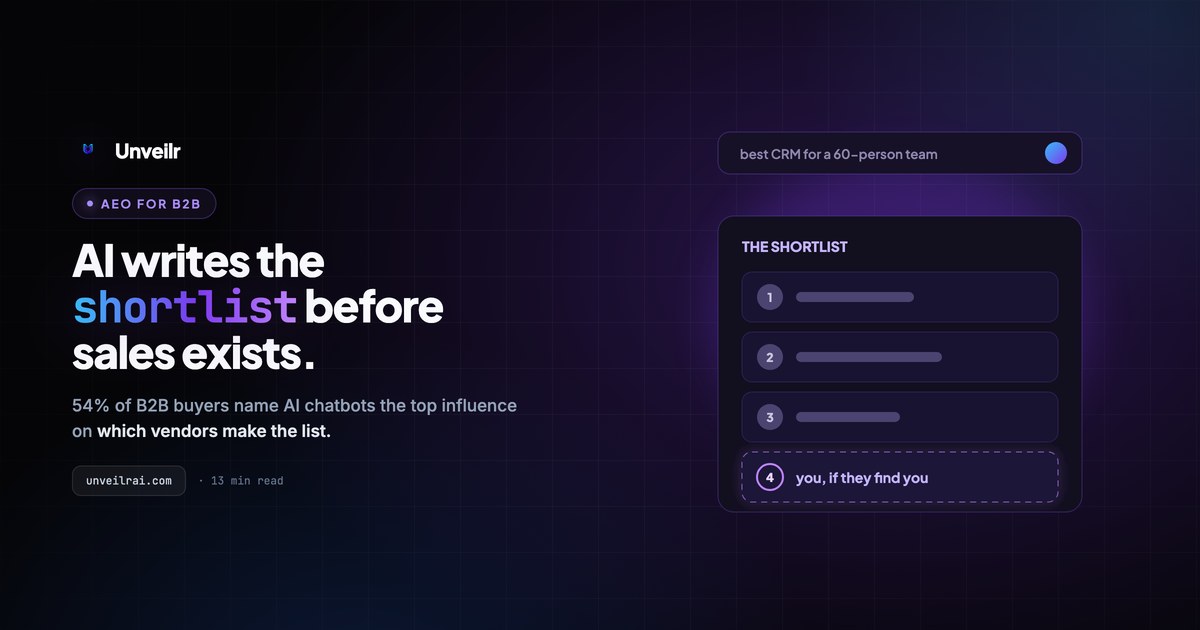
B2B buyers now build their shortlist with AI assistants, so AEO for B2B means earning citations in ChatGPT, Perplexity, Gemini, and Copilot when a buying committee researches vendors. Getting named once is not enough. You have to be corroborated across the review sites, analysts, and press those engines actually retrieve.
What is AEO for B2B?
AEO for B2B is making your brand the one AI assistants name and cite when a buying committee researches solutions. You earn that spot by building genuine notability across the sources engines retrieve, like reviews, analysts, and industry press, not by markup tricks. Think of it as the complete guide to answer engine optimization applied to a committee rather than a single shopper.
If you sell software, the same mechanics get more specific in our AEO playbook for SaaS. This guide stays general to any considered B2B purchase.
Why is B2B AEO different from B2C?
Five things separate B2B: a buying committee, a rep-free cycle, falling clicks, a high trust bar, and mid-funnel timing.
A committee, not a buyer
Gartner puts a typical B2B buying group at 6 to 10 decision-makers, and enterprise deals reach 11 or more. Each member independently gathers around 4 to 5 pieces of information. Every role, from security to finance to procurement, runs different AI queries.
A long, rep-free cycle
Most of the journey now happens without a salesperson. Gartner found 61 percent of buyers preferred a rep-free experience in 2025, rising to 67 percent in 2026. Forrester reports 94 percent of business buyers use AI somewhere in the process.
Fewer clicks, more answers
AI summaries are eating the click. Pew found the share of users clicking a result falls from 15 percent to 8 percent when an AI summary appears, and only 1 percent click inside it. That is why being cited in the zero-click answer now beats ranking below it.
A high trust bar
Getting mentioned is not enough for B2B. Gartner found 69 percent of buyers still validate AI-generated insights with a sales rep. In one 2026 survey, 20 percent of buyers, and 28 percent in procurement, felt less confident after an inaccurate AI answer.
Mid-funnel is where AI surfaces vendors
AI answers show up most at the shortlist stage. TrustRadius reports 83 percent of buyers shortlist three or fewer products. If AI does not name you there, you never make the list.
Which sources do AI answers pull from for B2B?
AI answers lean on notable, retrievable domains, and site-level notability is the top empirical predictor of citation. A large study tied citations to Tranco domain prominence, so known, reviewed, and analyst-covered brands win. For B2B, that means becoming a genuinely recognized brand.
The center of gravity is the review and comparison platforms: G2, Capterra, TrustRadius, and Gartner Peer Insights. TrustRadius reports 77 percent of buyers read user reviews, and review sites now outrank analyst firms at every stage. Analyst-report usage sits at an all-time low of 14 percent.
Beyond reviews, engines also pull from analysts like Gartner, Forrester, and IDC, plus trade press, digital PR, and your own comparison pages. Query fan-out then splits one buyer question into concurrent sub-queries, pulling from whichever notable domain answers each part, so you must appear across many, not just your homepage.
How does a buying committee change your AEO strategy?
Map each committee role to the AI prompts it runs, then make sure a notable source answers every one. Query fan-out turns one prompt into many, so role coverage decides whether you appear at all.
| Committee role | Example AI prompt | What AI needs to cite you |
|---|---|---|
| IT and security | "Is [vendor] SOC 2 compliant and how does it handle SSO?" | A crawlable security and compliance page |
| Finance | "What is the total cost of ownership for [category] tools?" | Transparent pricing and ROI content |
| Procurement | "Best [category] vendors with SLAs and support tiers" | Review-site profiles and clear SLA terms |
| End user | "Best [category] tool for [team], and the alternatives" | Honest comparison and alternatives pages |
| Legal | "Data residency and DPA terms for [vendor]" | Public docs on data handling and terms |
No single page answers all five, which is why AEO for B2B is a coverage problem, not a homepage problem.
The B2B AEO playbook: nine graded moves
These nine moves are graded by evidence quality, so you spend effort where it actually moves citations.
1. Be retrievable first (solid)
If crawlers cannot fetch you, nothing else matters. Allow OAI-SearchBot, Googlebot, PerplexityBot, and ClaudeBot, and server-render your pages, because most AI crawlers do not run JavaScript. Our guide to robots.txt for AI bots covers the exact rules.
2. Be the reviewed, analyst-covered brand (solid)
Notability is earned, so drive genuine review volume on G2, Capterra, TrustRadius, and Gartner Peer Insights. With 77 percent of buyers reading reviews and site notability the top predictor, this is the highest-impact move. Do not buy or fake mentions, since engines discount inauthentic ones.
3. Cover the buying-committee sub-questions (solid mechanism)
Build role-specific content for security and compliance, ROI and TCO, integration, and procurement and SLAs. Query fan-out splits one prompt into concurrent sub-queries, so each page can win a different part of the committee's research.
4. Create citeable notability with original data (solid)
Publish proprietary benchmarks or surveys and pitch them to trade press. Original data earns authentic third-party mentions and links, which is the kind of coverage engines retrieve. This is earned notability, not manufactured mentions.
5. Own the comparison layer (solid on intent)
Publish honest comparison pages: "X vs Y", "best category for segment", and "alternatives to" pages. These match shortlist-stage sub-queries, and with 83 percent of buyers shortlisting three or fewer, the comparison layer is where you make or miss the cut.
6. Engineer cross-source corroboration (contested)
Keep your category, positioning, and claims consistent across your site, review profiles, and press. The theory is that corroboration counters the 69 percent who fact-check AI with a rep, but the direct citation effect is not yet proven. Do it for trust, and treat the ranking benefit as provisional.
7. Write answer-first, extractable content (contested)
Answer-first formatting helps you get quoted once an engine has already retrieved you. It does not get you retrieved in the first place, so it is cheap insurance, not a growth driver. Our guide to structuring content for AI shows the format.
8. Feed the trust pages buyers and AI both check (solid-ish)
Publish transparent pricing, security and compliance details, and product docs as ungated HTML, not gated PDFs. TrustRadius reports pricing has been buyers' number one ask four years running, and gated PDFs are invisible to crawlers.
9. Measure honestly (solid)
Run each prompt 5 to 10 times per platform, because engines are noisy. Identical queries return only 0.34 to 0.42 Jaccard overlap, so a single check is meaningless. Separate mentions from citations, and track AI share of voice over time.
The repeat count is the step teams drop first, and dropping it quietly invalidates everything above it. Unveilr runs the scan on a frozen prompt set at that repeat count, so the noise floor stays constant between rounds and a real change stays readable against it.
Does traditional SEO still matter for B2B AEO?
Yes, and it may matter more than the GEO tactics sold as its replacement. Independent replication found traditional SEO significantly more effective than GEO content tricks, which failed to hold up. Google itself says optimizing for its generative features is still SEO.
Two myths waste B2B budgets. Ranking number one on Google does not guarantee AI citations, since only about 8 percent of ChatGPT citations come from Google's top 10 results. And a controlled test found schema markup produced roughly zero citation lift, slightly negative on AI Overviews.
What does move the number is the same short list every time: be retrievable, be reviewed, and cover the sub-questions the committee actually asks. How pages earn a ChatGPT citation works through those mechanics one engine at a time.
Frequently Asked Questions
Do B2B buyers actually use AI to research vendors?
Yes. Gartner found 45 percent of B2B buyers used generative AI to research vendors, and Forrester reports 94 percent use AI somewhere in the buying process. That usage concentrates in the early, self-serve phase, where buyers build a shortlist before ever talking to a sales rep. AEO is how you show up in that phase.
Does ranking number one on Google get us cited in ChatGPT?
No. Only about 8 percent of ChatGPT citations come from Google's top 10 results, so a great Google rank does not carry over automatically. AI engines run query fan-out and pull from notable review sites, analysts, and press. The fix is to cover the specific sub-questions your buying committee asks, on domains those engines already trust.
Will FAQ or schema markup get us into AI answers?
No. A controlled test found schema markup produced roughly zero citation lift, and slightly negative results on AI Overviews. Google also retired FAQ rich results on 7 May 2026. Keep schema for the rich results it still supports and for entity disambiguation, but do not expect markup alone to earn AI citations.
What sources do AI answers pull from for B2B?
Notable, retrievable domains. Site-level notability is the strongest predictor of AI citation, so engines favor review platforms like G2 and TrustRadius, analyst firms like Gartner and Forrester, and established trade press. They also read your own comparison and trust pages when those are crawlable. The through-line is being a known, corroborated brand.
Are review sites still worth it now that buyers use AI?
More than ever. TrustRadius reports 77 percent of buyers read user reviews, and review sites now outrank analyst firms at every stage of the journey. AI engines cite those aggregators heavily because they are notable and structured. Driving genuine review volume on G2, Capterra, TrustRadius, and Gartner Peer Insights is one of the highest-impact B2B AEO moves.
Should we block AI crawlers to protect our content?
Only if you want to disappear from AI answers. Blocking OAI-SearchBot removes you from ChatGPT, and blocking Googlebot removes you from Google AI Overviews and normal search. If your concern is model training, block the training-specific bots separately, and keep the search and answer crawlers allowed so you stay retrievable and citable.
Can we track one AI visibility score?
No, a single number hides too much variance. The same query returns only 0.34 to 0.42 Jaccard overlap across runs, so one check is unreliable. Run each prompt 5 to 10 times per platform, and report distributions rather than a point value. Also separate mentions, where you are named, from citations, where you are linked as a source.