

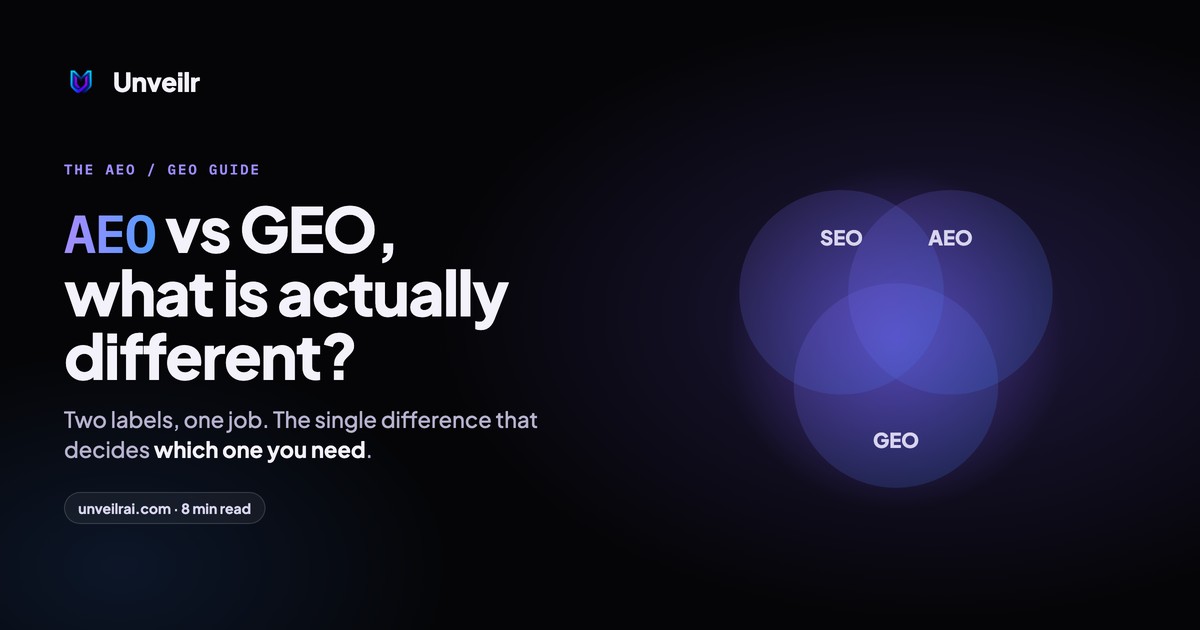
Quick Answer: AEO optimises a page to be the direct answer to one question, whereas GEO optimises a brand's footprint to appear in generated, multi-source responses. AEO is measured per question on ChatGPT, Perplexity and Google AI Overviews; GEO is measured as share of the whole synthesised answer. Most teams run both on the same content plan.
The two acronyms describe the same shift from the wrong end. AEO starts from the question a buyer types and asks which page will be quoted back. GEO starts from the engine and asks how a brand ends up inside whatever it generates.
That difference in starting point is the only one that changes what you do on Monday morning. Everything else, the engines, the crawlers and the page structure, is shared. The three-way comparison with SEO covers the classic search side; this page settles the two-way question.
What is the one difference between AEO and GEO
The deciding difference is the unit of work: AEO optimises a question, GEO optimises an entity. An AEO task is "make this page the answer to 'is AEO worth it'". A GEO task is "make this brand a source the engine draws on whenever it writes about AEO".
That is why the two produce different deliverables. AEO produces answer-shaped pages: a definition block, a fee table, a threshold, an FAQ that can be lifted verbatim. GEO produces evidence that a brand exists and is credible: consistent entity facts, third-party mentions, citations spread across the sources an engine fans out to.
Why the distinction survives the marketing noise
The term GEO comes from a November 2023 paper on generative engines, per its abstract on arXiv. It defined them as systems that "synthesize information from multiple sources and summarize them using LLMs". The optimisation target in that framing is visibility across a synthesised response, not the answer to one query.
An answer engine, by contrast, is "a tool designed to give you direct, detailed answers to your questions", which is how Perplexity's own help centre defines it. Optimising for that surface means optimising for the direct answer. Same engines, two different objectives.
AEO vs GEO at a glance
AEO and GEO share engines and crawlers but differ on target, deliverable, metric and time horizon. The table is the whole comparison in one place.
| Axis | AEO (Answer Engine Optimization) | GEO (Generative Engine Optimization) |
|---|---|---|
| Unit of work | One question, one page | One brand across a topic |
| Objective | Be quoted as the direct answer | Be a source inside the generated response |
| Typical deliverable | Definition blocks, tables, FAQs, threshold answers | Entity facts, third-party mentions, citations across many domains |
| Primary metric | Cited or named on a specific prompt | Share of voice across a prompt set |
| Engines | ChatGPT, Perplexity, Gemini, Claude, Grok, AI Overviews, AI Mode | The same engines |
| Content shape | Answer first, 40 to 60 word extractable block | Consistent claims repeated across owned and earned pages |
| Where it lives | Your site | Your site plus Reddit, YouTube, review sites, press |
| Time to first signal | Days on a fetchable page | Weeks to months as mentions accumulate |
| Failure mode | Right page, wrong question | Present everywhere, quoted nowhere |
How to read the table
Read the rows as two halves of one job rather than two competing methods. A page written for AEO with no entity support behind it gets fetched and skipped. A brand with strong GEO signals but no answer-shaped pages gets mentioned in passing and never linked.
How AEO earns a citation
AEO earns a citation when an engine fetches your page for a specific question and finds a passage it can quote. Google's documentation says AI Overviews and AI Mode "may use a query fan-out technique, issuing multiple related searches across subtopics and data sources", per the AI features guide for site owners. Each of those sub-searches is a question your page either answers in one passage or does not.
The AEO playbook is therefore page-level and mechanical. Match a real question in the H1, answer it in the first sentence, put the supporting fact in a table or list, and keep the page fetchable by the engine's crawler. Structuring content so an engine can lift it is most of the work.
What AEO does not do
AEO does not build the brand's standing outside your domain. If an engine's fan-out returns six Reddit threads and two review sites for a category question, and none of them mention you, the best answer page on your own site will still lose to the consensus in those sources.
How GEO earns a place in the answer
GEO earns a place in the answer when a brand appears often enough, and consistently enough, across the sources an engine retrieves that the synthesis includes it. The GEO paper reported that its methods "can boost visibility by up to 40% in generative engine responses" on its benchmark, per the abstract, and that effects varied by domain.
The GEO playbook is entity-level. Get the brand's facts identical everywhere (founding, location, category, product names), earn mentions on the domains the engine already cites, and publish claims with figures and sources attached. Entity signals that AI models learn are the foundation; what generative engine optimization covers is the fuller scope.
What GEO does not do
GEO does not guarantee a link. A brand can be named in a synthesised paragraph, correctly and favourably, with the citation going to a review site that described it. Being present in the answer and being the cited source are two different outcomes, and only the second sends a click.
Which one do you need
You need both, and you need them on the same content plan rather than as two budgets. The practical split is that AEO decides which pages you write and how, while GEO decides what has to be true about your brand off-site for those pages to win.
When AEO alone is enough
AEO alone works for narrow, factual questions where the engine wants one clean answer: a spec, a fee, a deadline, a definition you own. Pew found that Google searches phrased as questions produced an AI summary 60% of the time, per its July 2025 analysis, which is where a single well-shaped page pays off fastest.
When GEO has to come first
GEO has to come first on "best X" and "X vs Y" questions, because the engine is synthesising a consensus rather than quoting a fact. A brand absent from the retrieved sources is absent from the answer, however good its own page is. Measuring share of voice across a prompt set shows which of your prompts sit in this group.
How to run AEO and GEO together
Run them as one loop: pick the prompts, write the answer pages, then build the off-site evidence those pages need. The order matters because the answer page gives the mentions something to point at.
- List the prompts. Thirty to sixty buyer questions, split into factual (AEO-led) and consensus (GEO-led).
- Write one answer page per factual prompt. Question in the H1, answer in sentence one, a table or FAQ the engine can lift.
- Check what the engine fans out to on consensus prompts. Note the domains cited, and whether you are on them.
- Earn mentions on those domains. Reviews, community threads, video, press, all repeating the same entity facts.
- Re-scan on a fixed schedule. Read the live engine, not an API sample, and log named, cited and linked separately.
The one measurement that ties them together
Track "cited on prompt" for AEO and "share of voice across the set" for GEO on the same sheet. A rising share of voice with no citation means the page is missing or not extractable; a citation with flat share of voice means a GEO gap.
The pillar on answer engine optimization covers how the two metrics roll up into one report.