

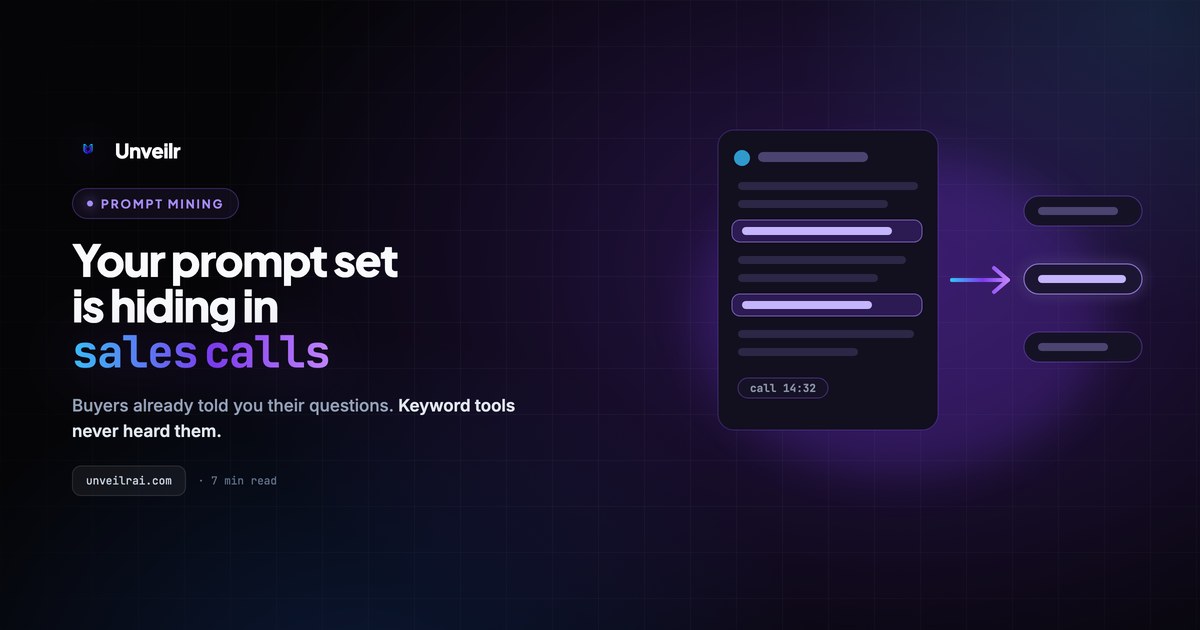
The best prompt set for a B2B company is already written down. It is sitting in your call transcripts, support tickets and win-loss notes, in the exact words buyers use when nobody is optimizing anything.
Keyword tools cannot see those words. They report what people type into Google, which is compressed and stripped of context, while the questions buyers ask an assistant are long, situational and specific.
The gap between the two is why prompt sets built from keyword data underperform. You end up competing on questions nobody asks, phrased in ways nobody phrases them.
Why are sales calls the better source?
Because a discovery call is a live recording of buyer questions at the moment of buying. No tool reconstructs that; you already have hundreds of hours of it.
The volume is the underrated part. A year of calls holds more phrasing variants than any keyword export, each attached to a real deal outcome you can weight by.
What do calls contain that keywords cannot?
Constraints and context. "We're a 40-person team on spreadsheets, is this overkill for us" is a prompt shape no keyword tool will ever surface, and it is exactly how the same buyer phrases the question to an assistant.
Objections too. The question behind a stalled deal ("how painful is migration, honestly") is a prompt your content has probably never answered, which is why the deal stalled.
And the pre-call questions. Buyers increasingly arrive having already asked an assistant about you, and what they say in minute five ("we read that you don't integrate with X") tells you exactly which wrong answer is circulating.
Which sources rank highest?
Not all recorded language is equal. Weight them by how close the speaker was to a purchase decision.
| Source | Signal quality | What it yields |
|---|---|---|
| Discovery and demo calls | Highest | Evaluation and comparison prompts |
| Win-loss interviews | Highest | The questions that decided deals |
| Support tickets | High | How-to and troubleshooting prompts |
| Onboarding questions | High | The gaps your content never covered |
| Community and social threads | Medium | Category language, unfiltered |
The top two rows are the ones keyword tools are structurally blind to.
How do you turn transcripts into prompts?
A repeatable pass, a few hours the first time. The discipline is keeping the buyer's phrasing instead of translating it into marketing language.
Step 1: Pull the questions verbatim
Go through recent calls and tickets and extract every genuine question a buyer asked, in their words. Transcript search makes the pass fast:
- Search question marks to catch everything phrased as a question
- Search "how do" and "what happens" for process worries
- Search "can it" and "does it" for capability checks
- Search "compared to" and "instead of" for the evaluation set
- Search "worried" and "concerned" for the objections nobody typed into Google
Resist cleanup. "Does this work if half our team is on the free plan" beats "freemium compatibility" precisely because it is unpolished.
Include the questions that embarrassed the demo. The ones the rep deflected are the ones the buyer took to an assistant afterwards, and they are the highest-value rows in the whole extraction.
Step 2: Cluster and deduplicate
Group phrasings of the same underlying question and keep the most natural one per cluster. Fifty raw questions usually collapse to fifteen or twenty real ones.
Do the clustering by meaning, not keywords. "Is migration painful" and "how long does switching take" are one cluster to a buyer, even though no word overlaps.
Keep a counter per cluster. The question asked on eleven calls outranks the one asked once, and that frequency is your prioritisation for free.
Note who asked, too. A question that only champions ask needs different content from one that only economic buyers ask, even when the words overlap.
Step 3: Sort by question shape
Bucket each prompt by what it retrieves: comparison and recommendation questions pull community sources and review platforms, while mechanism and process questions pull articles. The bucket determines the asset you build, which is the split that decides budget.
Keep a fourth bucket for accuracy prompts, the questions checking what assistants already claim about you. Those come straight from the pre-call objections and they get fixed, not written for.
Then tag intent. A pricing objection is commercial; a setup question is support content. Both matter, differently, and the commercial cluster is where movement eventually shows in share of voice.
Step 4: Run them before you build anything
Take the set across the engines, logged out, and record who wins each answer, the same mechanic as the free 20 minute check. Some prompts you already win. Some are lost to sources you can study.
And some return no citations at all, which is its own finding. A prompt answered from training data will not reward content, so it leaves the production list.
Log this per prompt rather than as one score. The useful columns are which competitor owns each answer and which source they won it with, because that is what tells you whether the fix is a page you write or a place you need to be mentioned. Run the first pass by hand even if you intend to automate it later, since reading the answers yourself is how you find out which of your prompts were badly phrased.
What does a good B2B prompt set look like?
Twenty to thirty prompts, weighted toward closed-won call questions, phrased as buyers phrase them, re-sourced quarterly. Small and real beats large and invented.
Specificity is why the small set wins. A generic category prompt is contested by a dozen vendors at once, while a call-sourced prompt carrying a real constraint often has no strong owner at all, so a set of twenty transcript-derived questions routinely outperforms a hundred invented ones.
The quarterly re-source matters more in B2B than anywhere. Your buyers' questions shift with your market, your pricing and your competitors' releases, and last year's prompt set quietly stops matching this year's calls. Fold the refresh into the same cycle as the broader audit.
One warning from experience: do not let the set drift toward questions you wish buyers asked. The transcripts keep you honest, which is the entire advantage of this method over brainstorming.
What ratio of question shapes is normal?
Most B2B sets land mechanism-heavy: roughly two thirds process, definition and troubleshooting questions, one third comparison and recommendation. That ratio decides where your answers will come from, so record it when you build the set.
If yours skews hard toward comparisons, community sources and review platforms will contest more of your answers, and the content plan should shift accordingly. The ratio is a property of your category, not a choice.
Who should own this?
Whoever reads the calls anyway. Product marketing usually, with sales handing over win-loss notes and support flagging recurring tickets.
The handoff is the failure point. A quarterly 30-minute review where sales brings five questions from lost deals is more durable than a tooling integration nobody maintains, and it feeds answer engine optimization with material no competitor can copy, because it comes from your pipeline and nobody else's.
That is the quiet moat here. Everyone can run the same keyword tools. Nobody else has your calls.