

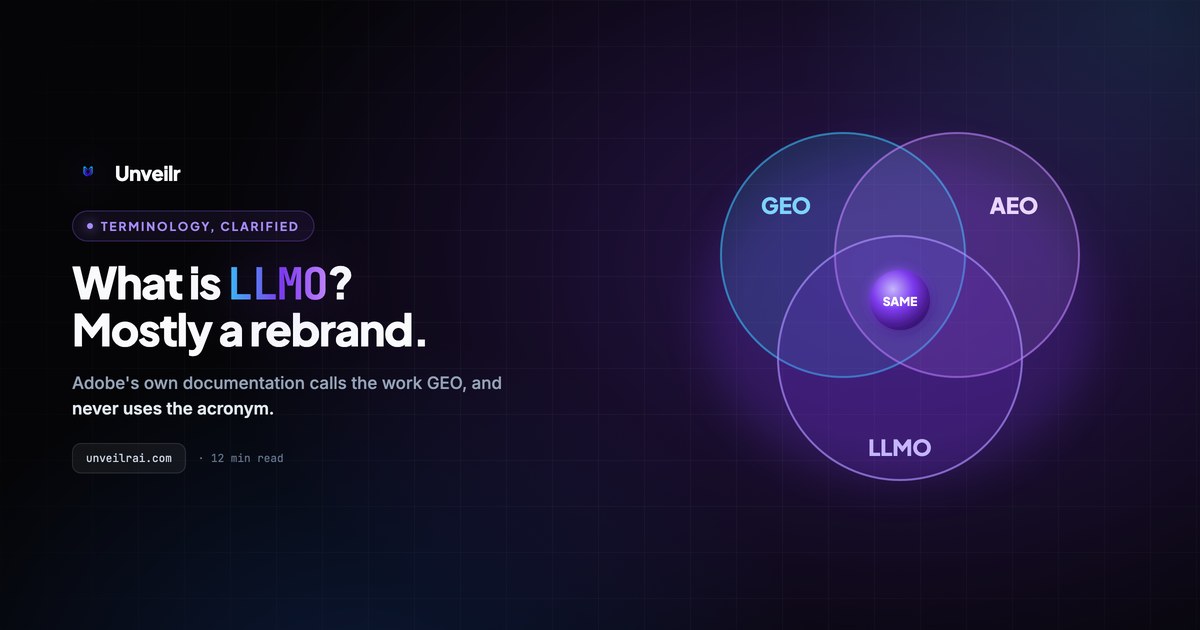
LLMO, or Large Language Model Optimization, is optimizing your content and brand so large language models, and the AI products built on them, mention and cite you. It targets the same outcome as AEO, GEO, LLM SEO, and AI search optimization: being surfaced in AI answers.
This page is about visibility optimization, not model operations. If you searched LLM optimization hoping to tune inference or fine-tune a model, you want LLMOps, which is a different field we separate below.
What is LLMO (Large Language Model Optimization)?
LLMO means optimizing your content and brand so large language models, and the AI search products built on them, name and cite you as a source.
The models include ChatGPT, Perplexity, Google AI Overviews and AI Mode, Gemini, and Claude. The goal is not a higher ranking. It is being the source the model repeats when it answers.
The stakes are the click. When an AI summary appears in Google, people click a link only 8 percent of the time, versus 15 percent without one. Being named in the answer is increasingly the whole game.
LLMO is a recent, marketing-coined label. Unlike generative engine optimization, which came from an academic paper, LLMO grew out of vendor and practitioner writing. The concept is real even if the name is new.
Is LLMO just a new name for AEO and GEO?
For most purposes, yes: LLMO is another label for the same discipline as AEO, GEO, and AI search optimization.
All of them chase one outcome, getting your brand mentioned and cited inside AI answers. They differ mostly in emphasis and in which surface they grew up around, not in the underlying work.
| Term | Where it grew up | Shared goal |
|---|---|---|
| SEO | Ranked blue links | Be found |
| AEO | Answer boxes and voice | Be the answer |
| GEO | Synthesized AI answers | Be a cited source |
| LLMO | LLM chat and AI search | Be mentioned and cited |
If you want the terms mapped side by side, the AEO vs SEO vs GEO breakdown and the LLM SEO glossary cover the vocabulary, and AI search optimization is the same idea under yet another name.
LLMO vs LLMOps: what is the difference?
LLMO and LLMOps sound alike but belong to different fields entirely. The acronyms differ by two letters. The disciplines share almost nothing: different teams, different tools, different definitions of success.
| LLMO | LLMOps | |
|---|---|---|
| Full name | Large Language Model Optimization | Large Language Model Operations |
| Field | Marketing and content | Engineering, a branch of MLOps |
| Goal | Be named and cited in AI answers | Keep an LLM application running in production |
| Typical owner | SEO, content, or growth | ML and platform engineers |
| Success metric | Citation and mention rate across engines | Latency, cost, eval scores, uptime |
| Typical work | Content, PR, crawl access, prompt tracking | Prompt versioning, retrieval pipelines, evals, monitoring |
| Touches the model | No | Yes |
The quickest way to tell which one you need is that LLMO never touches the model. It changes what the web says about you, so the model has better material to repeat. LLMOps changes the system around the model and never concerns itself with whether the public has heard of your brand.
The confusion is not helped by the phrase LLM optimization, which gets used for both. In engineering writing it almost always means model-side work: quantization, distillation, fine-tuning, inference speed, cutting cost per token. None of that appears on this page. If that is what you came for, LLMOps and MLOps are the terms to search.
One genuine overlap is worth knowing about. If you build an LLM product yourself, the retrieval side of LLMOps and the retrievability side of LLMO rhyme, because both care whether a document can be found and used. They act on different corpora, though. LLMOps makes your own documents retrievable to your own application. LLMO makes your public pages retrievable to somebody else's.
How does LLMO actually work?
The honest answer is that LLMO is mostly good SEO, pointed at AI answers instead of blue links.
Google puts it plainly: optimizing for generative AI search is optimizing for the search experience, and thus still SEO. An independent 2025 benchmark reached the same place, finding traditional SEO more effective than novel generative tactics.
Site-level notability is the top predictor
The strongest evidenced signal is simply being a well-known site.
In a 2025 study of 55,936 queries across six AI search engines, global site popularity by Tranco rank was the single most influential feature in a SHAP analysis, at 0.923. Being a genuinely known brand beats any markup trick.
Google is blunt about shortcuts here too. Seeking inauthentic mentions, in its words, is not as helpful as it might seem. Earn notability with real PR and a real product.
Cover the sub-questions AI asks
AI engines rarely answer a prompt with one lookup.
They decompose it into many sub-questions and retrieve a source for each, a pattern called query fan-out. Content that answers the whole cluster gets pulled more often than a page aimed at one keyword.
This is also why AI answers reach past the usual winners. In the same 2025 study, 37 percent of the domains cited by LLM search were unique to AI, not the classic top results.
Be retrievable
None of this matters if the engines cannot fetch your page.
Most AI crawlers do not run JavaScript, so server-render your important content and keep it in the initial HTML. Allow the retrieval bots in robots.txt, including OAI-SearchBot, Googlebot, PerplexityBot, and Claude-SearchBot.
Do these well and you have done most of LLMO. For one engine end to end, see getting cited by ChatGPT.
What does not work for LLMO?
Several popular tactics have little or no evidence behind them.
Schema markup is not an AI-citation lever. Google says structured data is not required for generative AI search, and an independent difference-in-differences test found roughly zero, slightly negative effect on AI Overview citations.
The llms.txt file does nothing today. No major engine uses it, and one audit found 97 percent of llms.txt files were never fetched. FAQ rich results also ended on 7 May 2026, so FAQ schema no longer earns that display.
E-E-A-T is not a ranking factor either. Asked directly whether E-E-A-T is a ranking factor, Google answered, in its own words, no, it is not. Write for trust because it helps readers, not because a score rewards it.
How do you measure LLMO?
You measure LLMO by tracking how often AI engines mention and cite you, not by watching keyword ranks.
Pick the prompts your buyers actually ask, then run each across ChatGPT, Perplexity, Gemini, and Google AI Overviews. Record whether you appear, and whether you are cited or just mentioned.
Run each prompt several times, because answers are unstable. Identical queries return overlapping but different sources between runs, with overlap around a Jaccard of 0.34 to 0.42. Five to ten runs per engine gives a reliable read.
Turn those runs into a share-of-voice number you can track over time. Our guide to measuring AI share of voice shows the method in full.
Frequently Asked Questions
What is LLMO?
LLMO, or Large Language Model Optimization, is the practice of optimizing your content and brand so large language models, and the AI search products built on them, mention and cite you. It targets the same outcome as AEO, GEO, LLM SEO, and AI search optimization. The label is newer and was coined by marketers, not researchers.
Is LLMO the same as GEO and AEO?
Effectively yes. LLMO, GEO, AEO, LLM SEO, and AI search optimization are near-synonyms for one discipline, getting your brand surfaced and cited inside AI answers. They emphasize slightly different surfaces, but the goal is identical. LLMO is simply the newest label, coined in marketing rather than in a research paper the way GEO was.
Is LLMO the same as SEO?
Largely yes, applied to AI answers. Google says optimizing for generative AI search is still optimizing for the search experience, and thus still SEO. An independent 2025 benchmark found traditional SEO tactics significantly more effective than novel generative tricks. Most of what improves LLMO is good SEO, done with citations in mind.
Is LLMO the same as LLMOps?
No, they are unrelated fields with similar acronyms. LLMOps, or LLM operations, is a branch of MLOps: the engineering work of deploying, monitoring, and maintaining LLM applications in production. LLMO is about visibility, getting mentioned and cited in AI answers. The simplest test is that LLMO never touches the model, while LLMOps is entirely about the system around it.
What actually works for LLMO?
Boringly, good SEO first. The best-evidenced levers are site-level notability, being a genuinely known brand, covering the sub-questions AI breaks a prompt into, staying crawlable so AI bots can retrieve you, and writing clear, extractable answers. Site popularity was the single strongest predictor of citation in a 2025 study across six AI engines.
Does schema or llms.txt help LLMO?
There is no good evidence for either. Google says structured data is not required for generative AI search, and an independent test found schema had roughly zero, slightly negative effect on AI Overview citations. The llms.txt file is ignored by every major engine, with one audit finding 97 percent of files never fetched.
How do I measure LLMO?
Run your priority prompts across each engine repeatedly and track how often you are mentioned or cited. Do not trust a single run, because identical queries return different sources between runs, with overlap measured at a Jaccard of only 0.34 to 0.42. Five to ten runs per engine gives you a stable share-of-voice read.