

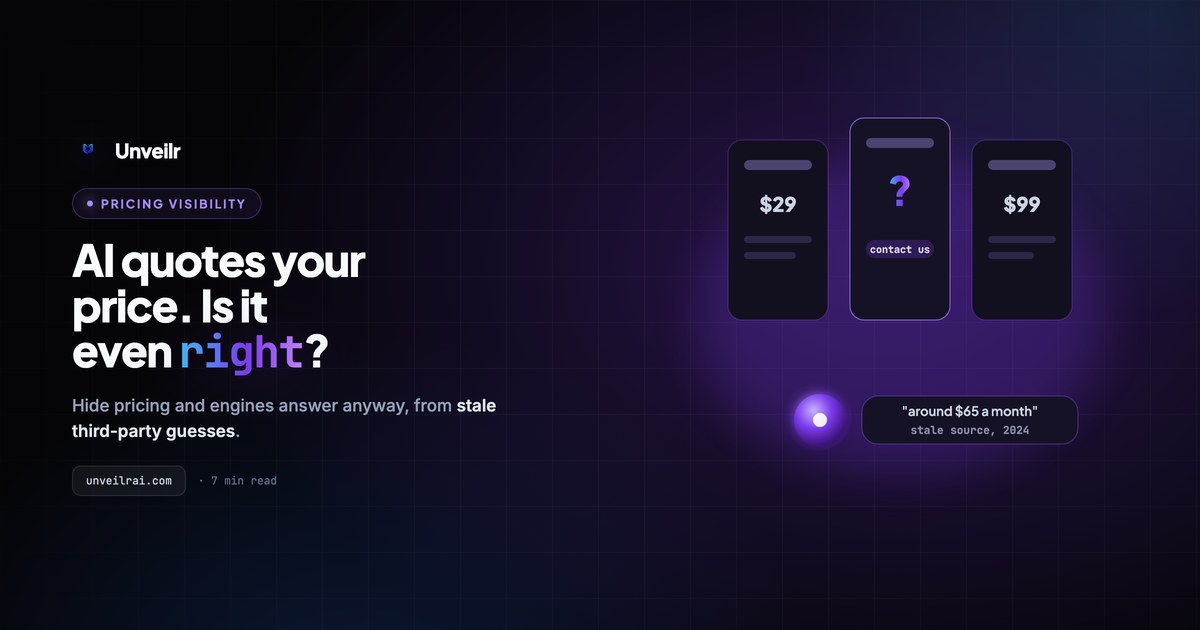
Ask an AI assistant what your product costs. If your pricing page says "Contact us", the answer will not be silence. It will be a number, assembled from stale review listings, old blog posts and forum guesses, stated with confidence.
That is the part SaaS teams miss about hidden pricing. The question gets answered either way; hiding the number only removes your version from the sources.
"How much does X cost" is among the most common buyer questions assistants receive, and for most B2B SaaS products the answer being served right now is someone else's reconstruction.
Where does AI get pricing when you hide it?
From everything except you. The retrieval stack for a pricing question has a predictable pecking order once your own page opts out.
Run the question yourself before reading on. Whatever number comes back is what your pipeline has been hearing, and it sets the stakes for everything below.
What are the substitute sources?
Review platform listings first, which carry pricing fields vendors filled in years ago. Then third-party pricing roundups, cost-comparison blogs, and community threads where someone shares what they pay.
Every one of those lags your current pricing. The listing shows the tiers from two repricings ago; the thread quotes a discounted contract; the roundup copied another roundup. The engine cannot tell, so it synthesises confidently from all of them.
Why does the wrong number stick?
Because those substitute sources persist and get re-crawled, exactly the property that makes any source citable. A stale price on a well-indexed listing keeps winning the answer until a stronger current source exists.
And corrections do not propagate backwards. Buyers who got the wrong number in an answer never visit to be corrected; they shortlisted or excluded you on the spot.
Currency conversions add a second layer of drift. A price quoted once in dollars resurfaces converted, rounded and years stale in other markets, still attributed to you.
What does hidden pricing actually cost?
Misqualification in both directions, at the moment of shortlist. This is a zero-click problem: the decision happens inside the answer.
- Excluded on a fake number. The assistant quotes an outdated enterprise price, and the mid-market buyer crosses you off without a visit.
- Included on a fake number. The opposite case burns sales time on buyers anchored to a price that no longer exists.
- Absent from cost comparisons. "Cheapest X for Y" answers skip vendors with no price data, handing the slot to transparent competitors.
- Anchored by competitors. When rivals publish and you do not, the answer frames your cost as "likely similar to" theirs, on their terms.
None of this appears in analytics, which is why it goes unmanaged. The buyer who never clicked leaves no trace.
What can you publish without publishing exact prices?
More than most pricing committees assume. The engine needs your framing, not necessarily your rate card.
What is the minimum viable pricing page?
Pricing model, tier structure, what moves the price, and a realistic starting range. "Per-seat, three tiers, from around $30 per user per month, enterprise custom" gives the engine a current, quotable, first-party sentence.
That single sentence usually beats the stale reconstructions, because it is fresher and it comes from the entity itself. Structure it as a standalone answer near the top of the page.
What if pricing is genuinely custom?
Publish the drivers instead. Which variables move the price, what a typical deployment looks like at three team sizes, and where the floor sits.
Buyers and engines both treat "here is how our pricing works" as an answer. It also pre-qualifies better than silence, which is what "Contact us" was supposed to do and does not.
Date the page. Pricing is the content type where freshness signals matter most, and a visible "updated" date tells both reader and engine the number is current rather than archaeological.
What about the FAQ layer?
Put the pricing questions buyers actually ask on the page, answered plainly: what is included per tier, how annual differs from monthly, what happens past a usage limit. These are exactly the follow-up prompts assistants field.
The same questions belong in your review-site listings' pricing fields, kept current. Those fields feed the substitute sources, so updating them shrinks the wrong-number supply directly.
How do you check what AI says about your pricing now?
Ask the engines the question buyers ask, in a logged-out session, and record every number and source that comes back. Ten minutes, and it is usually clarifying.
| What you find | What it means | The fix |
|---|---|---|
| Correct current pricing | A current source exists and wins | Keep it fresh |
| Stale tiers stated as current | A listing or roundup is winning | Update listings, publish your page |
| A confident wrong guess | No good source; the engine synthesised | Publish the minimum viable page |
| "Pricing not public, contact sales" | Rare honest case | Still losing cost-comparison prompts |
Fold the check into the free 20 minute brand check you run anyway, and re-check after any repricing. The window between your price changing and the answers catching up is when the damage concentrates.
Track it over time like any other prompt in your visibility measurement. Pricing prompts are commercial intent at its purest, and they deserve a permanent slot in the tracked set.
Logging which source supplied the number matters as much as logging the number. Unveilr keeps pricing prompts in the tracked set for that reason, so a wrong figure comes with the stale listing or thread that produced it, and the fix has a target rather than a guess.
What is the internal argument that wins?
The argument that wins is not transparency ideology. It is that the number already exists in the market, wrong, and publishing is the only mechanism that corrects it.
Sales objections soften when framed that way. Reps are already negotiating against phantom anchors the assistant handed the buyer, and a published range replaces a hostile anchor with yours.
The competitive-intelligence objection is mostly ceremony. Competitors already read your pricing from the same stale listings everyone else does.
The compromise position that works: publish the model and the floor, keep the ceiling for the sales conversation. That is enough for the engine to retire the reconstructions, which sits squarely inside answer engine optimization rather than pricing strategy.