

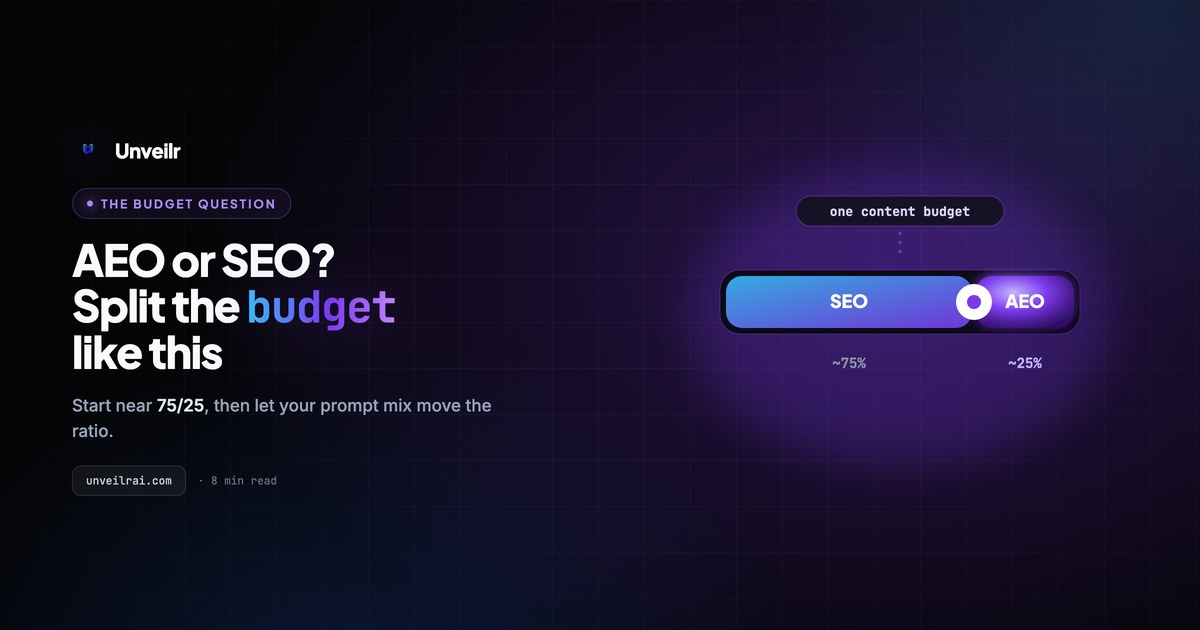
For most B2B SaaS teams the right split today is roughly 70 to 80% of the search budget on SEO foundations and 20 to 30% on AEO, shifting toward AEO as your buyers' questions migrate. Not because AEO matters less, but because it rides on infrastructure SEO pays for.
That number moves with your prompt mix, which is why this piece is about the decision method rather than a universal ratio. If you want the definitions, the AEO, SEO and GEO breakdown covers them; this is purely where the money goes.
One framing note first. The two budgets overlap far more than the acronyms suggest, and the overlap is the most important line item.
Why is this not an either-or decision?
Because the same content serves both surfaces, and the technical layer is shared outright. Crawlability, structured data, site health and topical depth feed rankings and citations simultaneously, which is why answer engine optimization is best budgeted as a layer, not a silo.
What does the shared layer cover?
Most of the content budget, honestly. A well-structured page with a direct answer up top ranks in Google and gets lifted by engines; you are not writing two libraries.
The two audits check different things, but they audit the same pages. Budget the production once and hold both bars against it.
What is genuinely AEO-only spend?
Prompt-set scanning, per-engine citation tracking, listing and off-site description hygiene, and content rebuilds targeted at specific lost answers. This is the 20 to 30%, and it is mostly measurement plus surgical fixes.
Review-site upkeep sits in this column for SaaS specifically. Listings contest your recommendation prompts whether you maintain them or not, so the hygiene hour is AEO spend by any honest accounting.
The reverse exists too. Link acquisition, SERP-feature chasing and rank tracking are SEO-only, and they are usually the mature line items you trim to fund the new column.
What decides your actual ratio?
Three inputs, all measurable before you move a dollar. Run them in order.
Where do your buyers ask questions?
Sort your prompt set by what each question retrieves, and check your funnel for AI-attributed signups. A category whose buyers ask assistants for shortlists justifies a heavier AEO share than one still living in Google.
If you have not measured, the free 20 minute check is the cheapest possible first reading. Guessing this input is how budgets end up performative.
The funnel side matters as much as the prompt side. AI-attributed trial share, even roughly measured, tells you whether the answer layer is already producing pipeline you are not crediting, and a channel producing uncredited pipeline is underfunded by definition.
How strong is your SEO base already?
AEO rides on crawl access, indexation and structure. A site failing its technical audit should fix that first, because retrieval cannot happen on pages a crawler cannot fetch, and every AEO dollar spent before access is confirmed buys nothing.
A mature SEO program, conversely, has already paid for most of what AEO needs. That is when the marginal dollar moves.
What does the competitive picture say?
Run your commercial prompts and see who owns the answers. A category where AI answers are contested by thin single-author sites is cheap to enter; one where the answers are settled costs more per citation.
Do the same in Google. The two competitive pictures routinely diverge, and the budget should flow toward the surface where you can actually move.
Divergence is the useful finding, not a nuisance. A category locked in Google and open in AI answers is precisely the case where the marginal dollar switches sides.
How do the two budgets differ in behaviour?
They pay back on different curves and fail in different ways, which matters more than the totals.
| Property | SEO budget | AEO budget |
|---|---|---|
| Payback curve | Slow build, durable | Faster on contested prompts, volatile |
| Failure mode | Rankings stall | Model update reshuffles answers |
| Measurement | Rankings, clicks, GSC | Presence and citation per prompt |
| Compounding asset | Domain authority | Entity clarity and citation history |
| Trim risk | Decays slowly if cut | Decays fast; loops stop compounding |
The volatility line deserves respect. A model update can reshuffle AI answers overnight, which argues for AEO spend structured as a standing loop with re-scans rather than one-off projects, and for judging it on share of voice trends over 8 to 12 week windows.
How do you run the reallocation?
Gradually, with the measurement in place before the money moves. The sequence that works:
- Baseline both surfaces first: rankings and traffic on one side, per-prompt presence and citation on the other.
- Fund the AEO measurement layer out of existing budget; it is small and it de-risks everything after.
- Move production toward dual-purpose content, answer-first pages that serve both bars, before funding anything AEO-exclusive.
- Trim the SEO line items with the weakest marginal return, usually link volume, not the technical base.
- Review the split quarterly against the trial-attribution and citation trends, not annually against a plan.
The mistake pattern is symmetrical. Teams either starve AEO because it lacks a decade of dashboards, or gut SEO for the new thing and lose the crawl foundation AEO stands on. The quarterly review against visibility measurement is what keeps the ratio honest in both directions.
What does this look like at different stages?
Seed-stage with thin content: nearly all foundation, because there is nothing for engines to retrieve yet. The AEO share is a measurement subscription and a prompt set, single-digit percent.
Even then, run the scans. Baselines built before you compete are the cheapest data you will ever collect, and they make every later budget conversation empirical.
Growth-stage with a working SEO engine: this is where 20 to 30% AEO earns its keep, funded mostly from low-yield link spend. The commercial prompts are contested and winnable.
Category leader: the ratio inverts on the margin. Rankings are defended cheaply, while every point of AI share of voice is contested by challengers, and defence of the answer layer becomes the growth spend.
How do you report the two columns together?
The budget conversation stays stuck when the columns report in different units. SEO arrives as rankings, sessions and impressions. AEO arrives as presence on a prompt. Side by side, one reads like a business and the other reads like a science project, and the newer column loses that comparison regardless of what it is actually producing.
Fix the units rather than the argument. Report both as movement against a baseline over the same window: rank and click change on one side, presence and citation change per prompt on the other, with AI-attributed trial share sitting underneath both. That is a table a CFO can read, and it is the only version of this conversation that survives a bad quarter on either side.
Keep the prompt-level detail beneath the summary. An aggregate visibility score with nothing under it is the fastest way to lose the line item the first time it dips, because you cannot say which answers moved or why. Unveilr reports the AEO column in that shape, per prompt against a baseline, which is the format a quarterly review needs whether the loop runs in-house or not.